
Walk-In Mobile MRI · Toronto, Ontario
Apex WalkIn MRI
The first walk-in MRI trailer. Modular access. Mobile freedom.
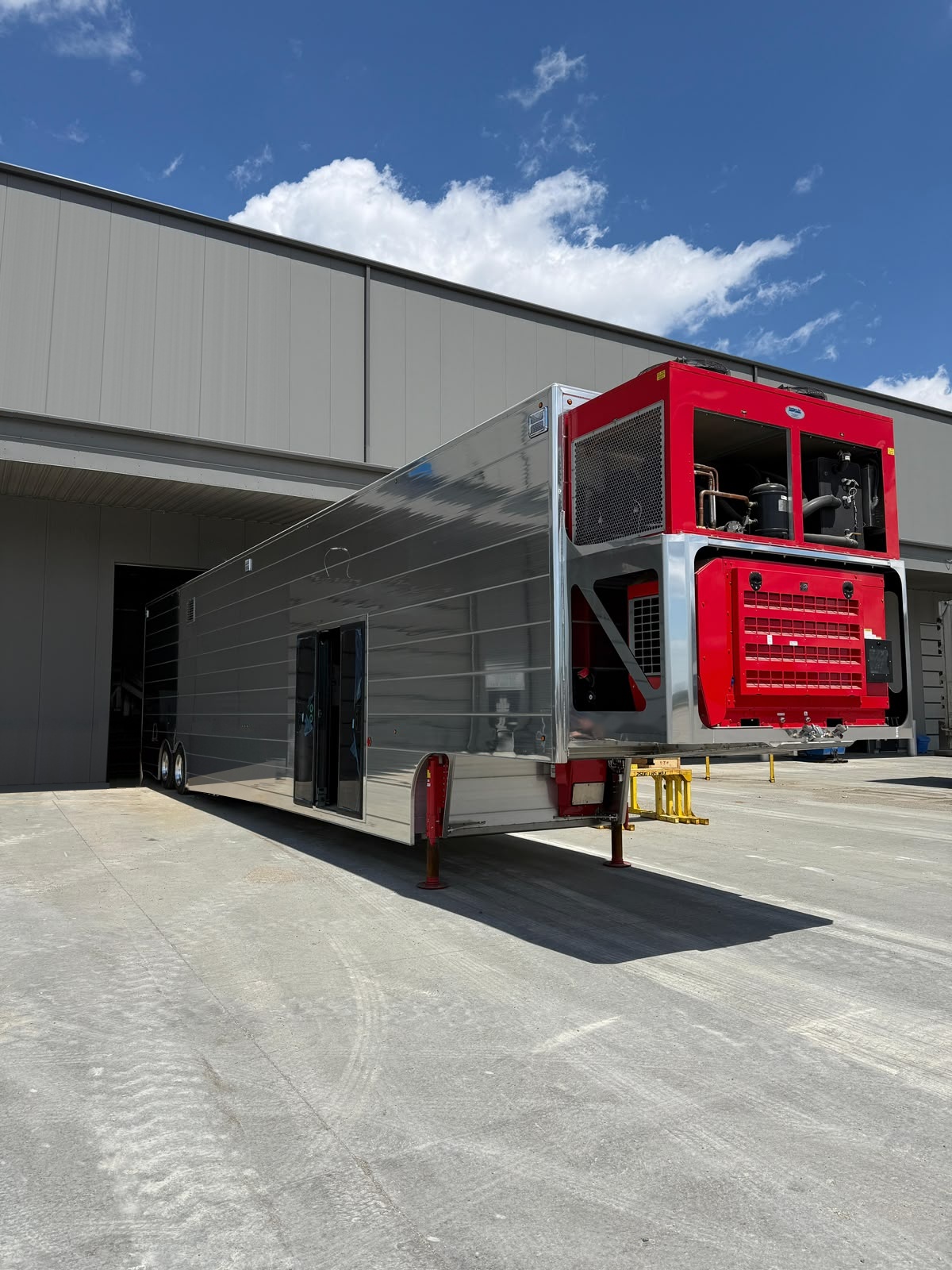
The Solution
Ten inches from the ground.
The Apex entrance sits just 10" from the ground. It works on the low-floor bus principle, with wide double sliding doors. Wheelchairs, walkers, stretchers, elderly and mobility-impaired patients simply walk in.
Step-Free Entry. No lift cycle, no transfer, no staircase.
10 in
60 in
Apex WalkIn MRI
Step-free entry, no Lift
Conventional trailer
Requires a Lift or staircase
The Problem
Every patient starts with a climb.
Conventional MRI trailers sit about 60" (1.5 m) off the ground. Every patient reaches the scanner by lift or staircase — a wheelchair lift cycle, a transfer, a staircase in winter weather. The access equipment becomes part of the workflow, and part of the wait.
Built for Deployment
Arrives like a trailer. Works like a building.
No Lift
No wheelchair Lift, no stretcher Lift, no Lift cycle — patients roll straight in at 10" from the ground.
Standard truck delivery
No oversize load permit required.
No crane
The unit arrives and sets without lifting gear.
No pad or foundation
No civil works to schedule or fund.
No building permit
It remains a mobile trailer.
Magnet stays on field
The magnet remains on field in transport.
Greater ceiling height
More interior height than a conventional mobile trailer.
Days, not months
Deployment measured in days.
Relocates easily
Move the unit to another site without civil works.
Compare the Options
Three ways to bring MRI to a site.
Swipe the table sideways to see all three options.
| Criteria | HighlightedApex WalkIn MRI | Conventional Mobile MRI | Hybrid / Modular MRI |
|---|---|---|---|
| Patient entry | 10", step-free | ~60", lift or stairs | About 10", like the Apex |
| Delivery | Standard truck | Standard truck | Oversize load, permits |
| Crane | No | No | Yes |
| Pad / foundation | No | Usually a pad | Yes |
| Building permit | No | No | Usually yes |
| Magnet in transport | On field | On field | Usually ramped down |
| Ceiling height | Higher than a mobile trailer | Low | High |
| Setup time | Days | Days | Weeks to months |
| Relocation | Easy | Easy | Major project |
“Everything a modular MRI gives patients, delivered like a mobile trailer: no crane, no foundation, no permit, no stairs.”
Use Cases
Where it earns its place.
Interim capacity
Coverage during renovation or equipment replacement.
Backlog reduction
Added throughput where wait lists are long.
Permanent satellite imaging
A standing imaging point away from the main campus.
Rural, remote and First Nations communities
Diagnostic access without construction.
Private imaging operators
Fast entry into new catchment areas.
Research and clinical trials
Imaging capacity at a study site without taking hospital scanner time.
Technology
Designed for Siemens MAGNETOM mobile MRI systems.
The trailer is engineered around the scanner: shielding, cooling, power and patient circulation are all set out for a 1.5T mobile MRI system that stays on field between sites.
- Scanner platform
- Siemens MAGNETOM mobile MRI systems
- Field strength
- 1.5T superconducting magnet
- Magnet in transport
- Stays on field — no ramp-down between sites
- Ceiling height
- Greater than a conventional mobile trailer
- Patient entrance
- 10" step-free, wide double sliding doors
Scanner panel
Siemens MAGNETOM, at a glance
- Field strength
- 1.5T superconducting magnet — the magnet stays on field between sites, so there is no ramp-down and ramp-up cycle when the trailer moves
- Scan time
- Set by your protocol, not by the trailer — a typical clinical exam runs in the region of 15 to 45 minutes, and the trailer adds no transfer or lift cycle before it because patients walk in at 10" from the ground
- Imaging capabilities
- Neuro, spine, musculoskeletal, body, breast and MR angiography — protocols and coils follow the scanner your team specifies
- Bore and patient table
- Standard mobile MAGNETOM bore and table — full ceiling height in the scan room keeps head-first and feet-first positioning workable
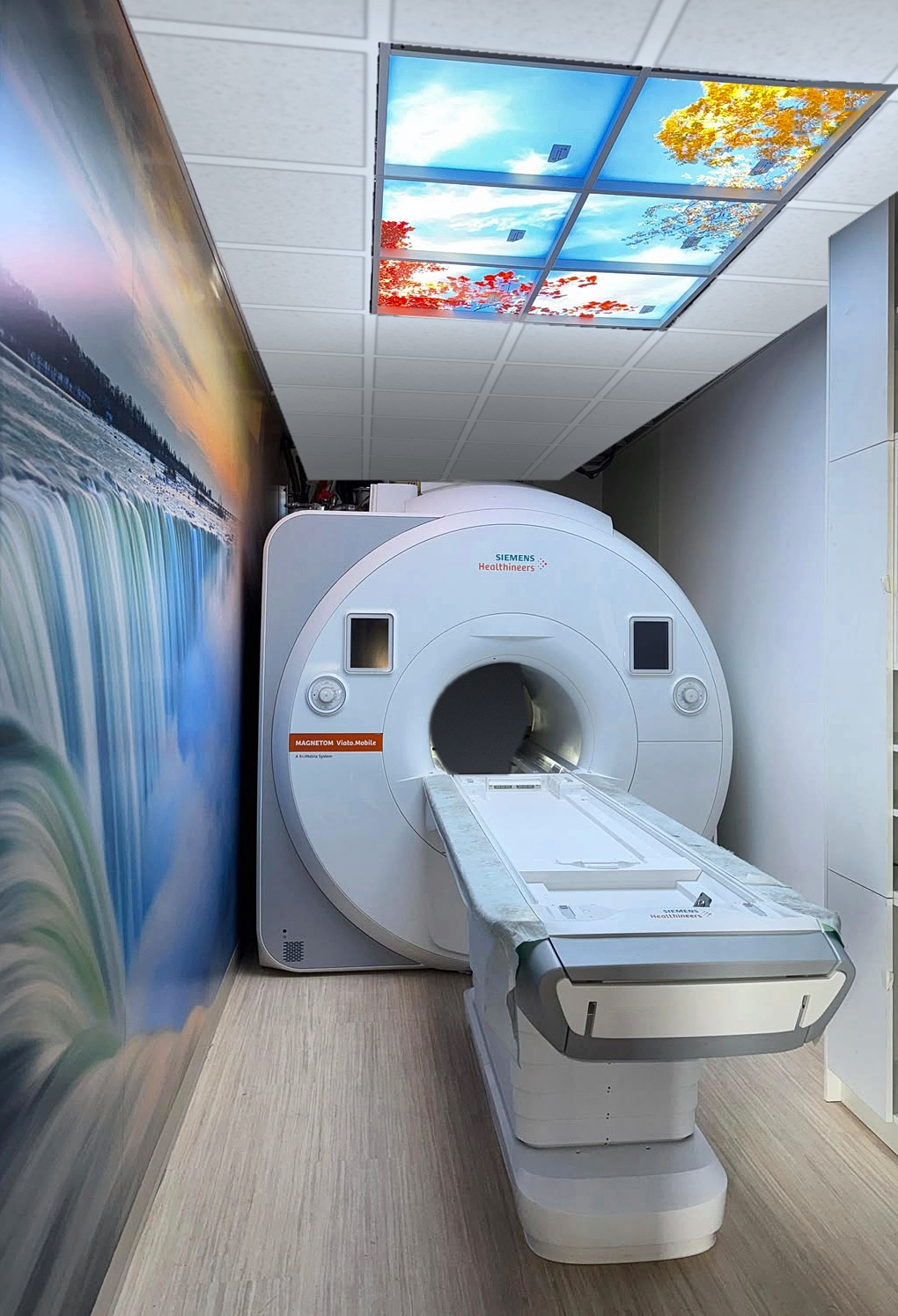
RF-shielded scan room
A shielded enclosure built into the trailer body, with penetration panels for power, gas and data.
Climate and magnet cooling
Dedicated HVAC for the scan room and equipment bay, with cryogen vent routed to roof level.
Power and shore connection
Shore power connection with onboard distribution; generator provision available on request.
Control and patient areas
Operator console position with scan room window, plus changing and patient preparation space.
Imaging
The exams your programme already runs.
Protocols and coils follow the scanner your team specifies — the trailer does not limit what the system can do.
Neuro — brain and head
Spine — cervical, thoracic, lumbar
Musculoskeletal — knee, shoulder, hip, extremities
Body — abdomen and pelvis
Breast imaging
MR angiography
Service
From engineering to the day you move it.
Engineering & build
Trailer designed around your scanner model, site access and patient flow, then produced in Toronto.
Delivery & siting
Standard truck delivery, positioning and connection to shore power and site services.
Relocation
Move the unit between sites without a crane, pad or permit; setup is measured in days.
Service & maintenance
Ongoing support for the trailer envelope, shielding, HVAC and electrical systems.
Programs
Design & Production · Sales · Rent.
Design & Production
Purpose-built trailers engineered around your scanner, site and patient flow, produced in Toronto.
Sales
Own the unit outright, configured for your program and delivered by standard truck.
Rental
Short or long-term placement for interim capacity, backlog work or seasonal demand.
The WalkIn Family
One platform, more modalities.
WalkIn MRI
Available nowWalkIn CT
Coming soonWalkIn PET-CT
Coming soonQuestions
WalkIn MRI & WalkIn CT, answered.
Anything not covered here, ask us directly — we will answer with specifics for your site and scanner.
What makes the Apex WalkIn MRI a walk-in trailer?
The entrance sits just 10" from the ground, against roughly 60" on a conventional mobile MRI trailer. It works on the low-floor bus principle, with wide double sliding doors, so wheelchairs, walkers, stretchers, elderly and mobility-impaired patients simply walk in — no lift cycle, no transfer, no staircase.
Does the site need a crane, a pad or a building permit?
No. The unit is delivered by standard truck without an oversize load permit, sets without lifting gear, needs no pad or foundation, and requires no building permit because it remains a mobile trailer.
How long does deployment take?
Deployment is measured in days rather than the weeks or months a hybrid or modular installation takes. Relocating the unit later is equally straightforward.
Is the magnet ramped down for transport?
No. The magnet remains on field during transport.
Which scanners does the trailer suit?
The Apex WalkIn MRI is designed for Siemens MAGNETOM mobile MRI systems, with interior ceiling height greater than a conventional mobile trailer.
Is the WalkIn CT available yet?
The Apex WalkIn CT is coming soon, alongside the WalkIn PET-CT. Both are built on the same walk-in platform as the MRI: the 10" step-free entrance, standard truck delivery and no crane, pad or permit. Talk to us about timing for your program.
Can we rent instead of buying?
Yes. Apex offers design & production, outright sale and short or long-term rental — for interim capacity during renovation, backlog work, satellite imaging or seasonal demand.